


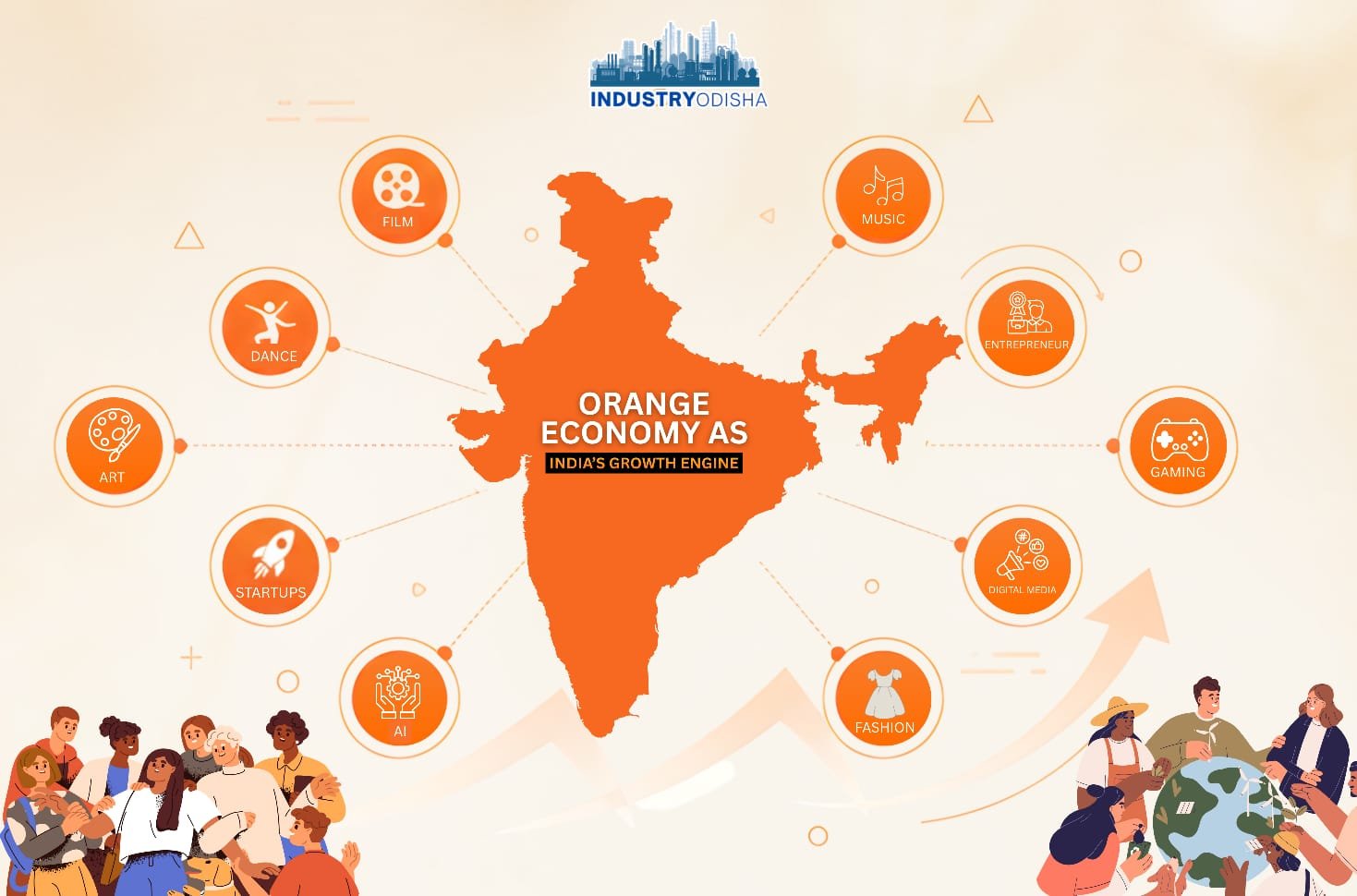
As the Gig economy grows, the concept of compact cubicles and offices filled with piles of papers are gradually vanishing. Gen Zs, Gen Alphas are channelising their creative talent into an income source and leading orange economy. The term was coined by former Colombian president Iván Duque Márquez and Felipe Buitrago in the book The Orange Economy: An Infinite Opportunity in 2013. It gained traction after orange economy found its mention in the budget 2026.
Orange Economy: the creative sector
Orange economy, also called Creative Economy encompasses- Animation, Visual effects, gaming and comics (AVGC), film, music and digital storytelling, design, fashion and advertising, publishing and software tools for content creation and distribution. Quite contrary to traditional sectors, this sunrise sector earns primarily from Intellectual property (IP) and digital connect.
Over the years, it has contributed to India’s economic growth. It has an employment share of 8% and is a $3 billion worth market. This also amplifies the Global Innovation Index (GII), published annually by World Intellectual Property Organisation (WIPO). The Union Budget 2026-27 has explicitly taken cognizance of the potential, orange economy can provide.
Budget provisions for growth of orange economy:
FM Nirmala Sitharaman in her Budget speech, termed it a growing industry with a workforce capacity of 2 million professionals by 2030. Indian Institute of Creative Technologies, Mumbai will set up AVGC Content Creator Labs in 15,000 secondary schools and 500 colleges. This was described by the Honourable FM as “creating pathways from classrooms to creator careers.” For the growth of this sector, allocations to the tune of Rs 450 crore has been set aside.
OTT platforms emerging in most regional languages catalysed growth of this sector and drew a major mass of the society as its devoted consumers. The skilled human capital coupled with cost efficiency will generate, resources for the creative untapped talent.
After government formally recognised it, the dreams of many imaging a gaming world or taking up filmography will no more be considered a taboo. This skill is likely to be welcomed and in fact be rewarded now. The ball is now in the court of the country’s policymakers, universities and industry leaders to address the creativity.
